Trigonometry
Trigonometry is one of the subjects in mathematics that studies the ratios between sides of right-angled triangle.
Sine, Cosine, and Tangent Ratio
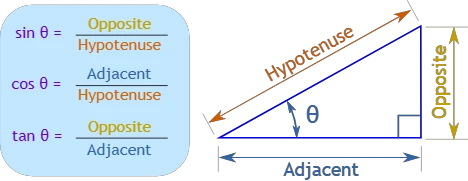
SOH CAH TOA
Calculating Sides
1. Find the length of side a.
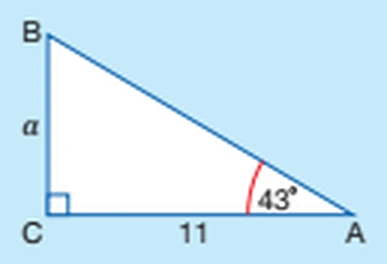
The information given is the adjacent side of the given angle, and the question is the length of opposite side, so we use tangent ratio.
2. A boy is flying a kite at the end of a 10 m string. The angle of elevation of the kite from the boy is 32°. Find the height of the kite.
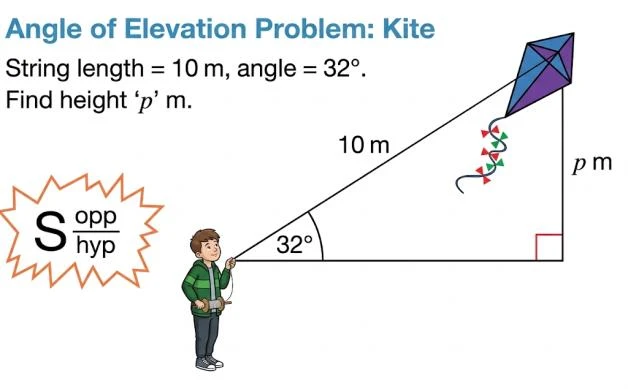
The information given is the hypotenuse side of the given angle, and the question is the length of opposite side, so we use sine ratio.
So, the height of kite is 5.3 m.
3. Find the length of side q correct to 3 significant figures.
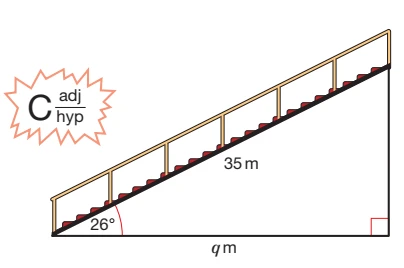
The information given is the hypotenuse side of the given angle, and the question is the length of adjacent side, so we use cosine ratio.
So, the value of q is 31.5.
Calculating Angles
1. An aeroplane takes off from point A at angle of elevation θ°. Calculate θ.
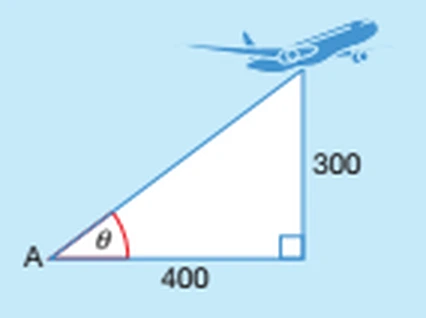
The information given is the length of opposite and the adjacent side, so we use tangent ratio.
2. An isosceles triangle of sides 100 cm, 60 cm and 60 cm has a base angle θ. Find θ.
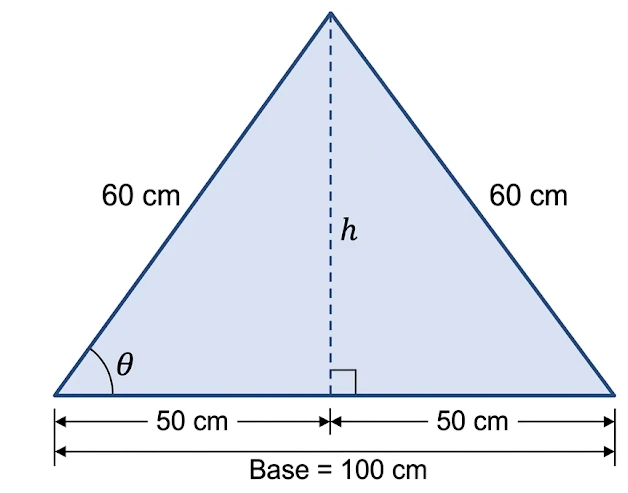
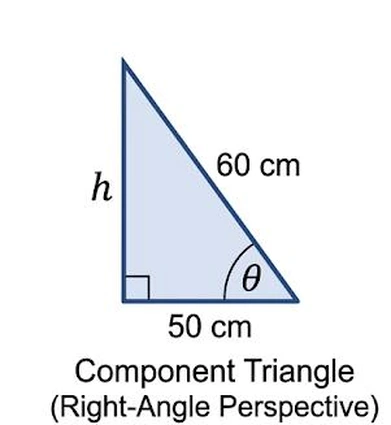
To find the value of θ, we can use cosine ratio,
Exercise
- A hawk sits on top of a tree and sees a mouse on the ground at an angle of depression 25°. The mouse is 25 m away from the base of the tree. Find the height of the tree.
- A hot-air balloon rises vertically from the ground stopping h₁ m above the ground before rising h₂ m further.
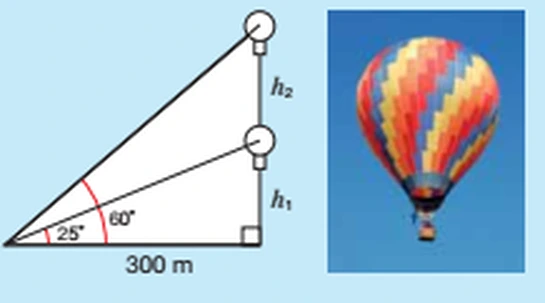
- Find the heights h₁ and h₂.
- The balloon takes 1 minute to rise from the ground to h₁ m. It takes a further 5 mins to rise to its highest point. Calculate the average speed of the total ascent in m/s.
- Zeno sails his boat 20 km from Port A on a bearing of 030° to point B. He then sails 10 km on bearing 120° to point C arriving at 3 pm. A storm warning tells him to return directly to Port A before 5:15 PM.
- Draw a diagram of Zeno's route and use it to find the bearing of his return journey.
- If distance CA = km and he returns at 10 km/h, find out whether he returns to Port A before 5:15 PM.
Answer
1. This is the illustration of the problem.
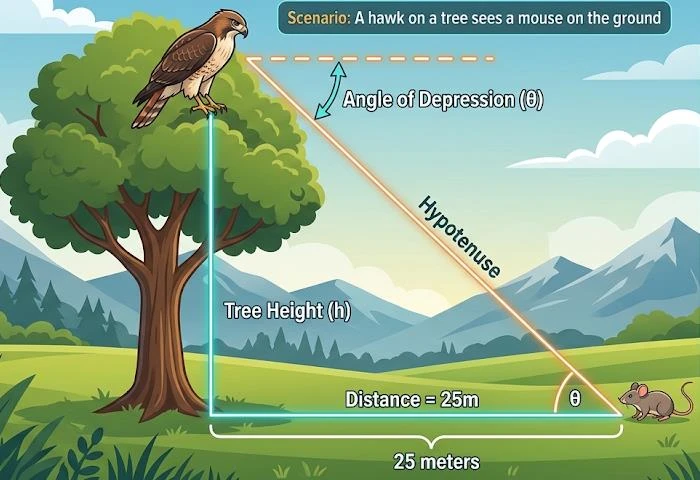
It is given that the angle of depression is 25°, then it is equal to the angle of elevation from the mouse to the hawk. The height of the tree can be found by using tangent ratio,
So, the height of the tree is 11.7 m.
Past Paper Questions
Cambridge Mathematics IGCSE 0580/22 March 2026
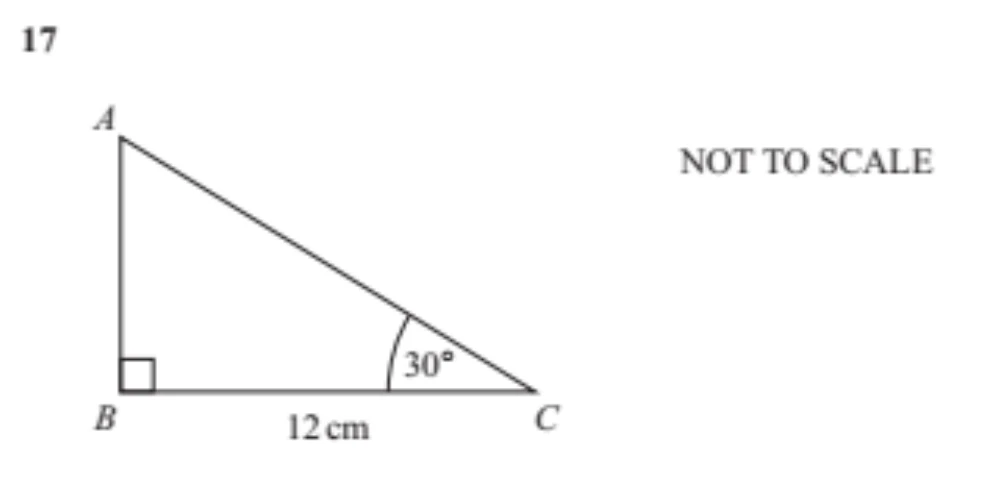
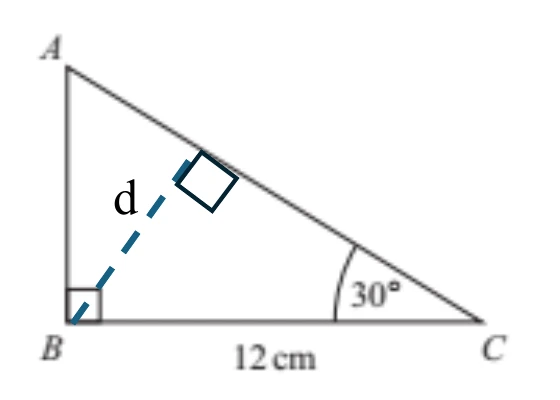
(a) Find the length of AC.
Give your answer in the form . [4]
(b) Find the shortest distance from B to AC. [3]